

Looks like they have a decent lineup scheduled…any of you guys going?
What’s new in 6.0rc8 (2013-Feb-04 13:25):
*) ppp,pppoe,pptp,l2tp,sstp – only 2 change mss mangle rules are created for all ppp interfaces;
*) wireless – fixed AES encryption speed issues (upgrade suggested);
*) dhcpv6 server – handle info requests;
*) webfig – compressed all html resource files, speeds up opening of webfig page;
*) console – reduced width of address column in ‘/user print’;
*) simple queues requires target arg to be specified when adding;
*) do not count packets for unknown protocols as rx_dropped;
*) snmp – provide POE info;
*) improved cpu usage reporting on CCR boards;
*) improved interface reading performance;
*) changed CLI interface order – first are ethernets, second wireless, third everything else.
Within group interfaces are ordered by name;
*) interfaces are deleted much faster, could be bottleneck on systems with many ppp sessions;
*) pptp,l2tp,6to4 tunnel encapsulation/decapsulation now resets packet marks to
have consistent behavior across tunnels;
*) fix simple queue interface matching when doing encapsulation in some tunnel,
could result in double accounted packets;
*) ip/ipv6 firewall has all-ether,all-wireless,all-vlan,all-ppp interface matchers
*) queue limits could be inaccurate for large limits (100M or more);
CAVEAT:
*) bgp peer tcp-md5-key is not supported on CCR (to be fixed in next release);
I don’t normally post up RC info, but since all of my CCR peeps are going to want it, here you gooooooo.
Odd, they left off the openflow info. Perhaps it was only available for the pre-release crowd(this is the part where I pretend to be Superior). *EDIT* They’ve now added it back 🙂
This is an email conversation between JJ, Greg, Mike, Andrew Cox, Andrew Thrift, Justin, Tom, and others. I thought you guys might find this interesting.
We have been working on a mast site ( revisiting it since ) our Work on spacing out the Antennas last year,
I was wondering about your opinions.. on Sectors…
we have been using Pac wireless ones / Laid ones which seemed to have good range and great noise rejection (front to back)
we started using Sunparl Dual Polarity sector Antennas. they look impressive all metal enclosure etc… … and had great signal strenghths however compared with Pac wirelsss we have seen other neighbouring sectors at -15 ( as opposed to –45 / -50 on Pac wireless dishes)…
what I was wondering was what is your experience with sectors… are the UBNT Sectors good ? I have never used them out of prejudice….
What have you used and what would you recommend ?
any pointers would be much appreciated…
PS I love Jirous Dishes (Extreme) for Point to Point Links 🙂
_+_+_+_+_+_+_+_+_+_+_+_+_+_+_+_+_+_+_+_+_+_+_+_+_+_+_+_+_+_+_+_+_+_+_+_+_+_+_+_+_+_+
I have somewhere in the neighborhood of 100+ ubuquiti antennas on towers / poles / cow pastures. I have been very impressed. I love that all of them are dual poll for a minimum amount of money. I love the new titanium sectors better rejection selective beam. Tho only bad thing I can think to say is the non titanium ones have what seems to be rivets around the rp-sma connector that seem to rust pre maturely.
I would have to say go for it! I think you will be happy… We are.
_+_+_+_+_+_+_+_+_+_+_+_+_+_+_+_+_+_+_+_+_+_+_+_+_+_+_+_+_+_+_+_+_+_+_+_+_+_+_+_+_+_+
I’ve heard that(from JJ I think) for the price the UBNT antennas have the best design. I’ve had good success with them also.
_+_+_+_+_+_+_+_+_+_+_+_+_+_+_+_+_+_+_+_+_+_+_+_+_+_+_+_+_+_+_+_+_+_+_+_+_+_+_+_+_+_+
We use the 120 degree ubnt sectors (5g19 i think) with ubtik enclosures. Mikrotik with ubnt antennas win win I’m my book.
_+_+_+_+_+_+_+_+_+_+_+_+_+_+_+_+_+_+_+_+_+_+_+_+_+_+_+_+_+_+_+_+_+_+_+_+_+_+_+_+_+_+
Jirous looks great. I’d love to try them sometime.
I used to love MTI sectors, but they’re so damn expensive.
_+_+_+_+_+_+_+_+_+_+_+_+_+_+_+_+_+_+_+_+_+_+_+_+_+_+_+_+_+_+_+_+_+_+_+_+_+_+_+_+_+_+
Thanks for that… I really appreciate.. it…
I presume you would recommend the RF Armour … as well ?
_+_+_+_+_+_+_+_+_+_+_+_+_+_+_+_+_+_+_+_+_+_+_+_+_+_+_+_+_+_+_+_+_+_+_+_+_+_+_+_+_+_+
I second the ubnt sectors. No firsthand experience with the titaniums yet. I do have experience with the rf armor shields though. Very happy with the ubnt+ rf armor.
_+_+_+_+_+_+_+_+_+_+_+_+_+_+_+_+_+_+_+_+_+_+_+_+_+_+_+_+_+_+_+_+_+_+_+_+_+_+_+_+_+_+
I have a couple Titaniums, but nothing much to offer any insight from. I certainly like the mechanical setup of Titaniums vs. standard + RF Armor.
_+_+_+_+_+_+_+_+_+_+_+_+_+_+_+_+_+_+_+_+_+_+_+_+_+_+_+_+_+_+_+_+_+_+_+_+_+_+_+_+_+_+
We have tried the Laird, Sunparl and UBNT sectors.
I too really like Sunparls enclosure, but the brackets and lack of protective coating on the pcb let them down. Also we got a fair bit of noise with them.
The ubnt dual polarity sectors are what we use and recommend. They are good quality and the brackets are really nice.
All our back hauls are now Jirous, its good to see more people discovering them 🙂
_+_+_+_+_+_+_+_+_+_+_+_+_+_+_+_+_+_+_+_+_+_+_+_+_+_+_+_+_+_+_+_+_+_+_+_+_+_+_+_+_+_+
What say you guys? Drop us a comment!
What’s new in 5.23 (2013-Jan-29 14:07):
*) lcd – changed gamma, which gives greater contrast
*) fix reboot when running on third party hypervisors;
*) ppp client – fixed possible loss of configuration after reboot for some modems;
*) fixed wifi led order on “SXT Lite5”;
*) wireless – improved nv2; Sounds like something…only what could it be…hehe
As of RouterOS V6 RC8, Mikrotik has integrated an Alpha version of OpenFlow. The first thing I said was “Oh neat…what is OpenFlow?”
OpenFlow is an open standard that enables researchers to run experimental protocols in the campus networks we use every day. OpenFlow is added as a feature to commercial Ethernet switches, routers and wireless access points – and provides a standardized hook to allow researchers to run experiments, without requiring vendors to expose the internal workings of their network devices. OpenFlow is currently being implemented by major vendors, with OpenFlow-enabled switches now commercially available.
What does this really mean, though?
You start with an OF switch and a controller. The OF switch is a switch/router/access point that runs the OF client. Most switches have a “flow table” built from TCAM. This flow table determines which traffic moves where.
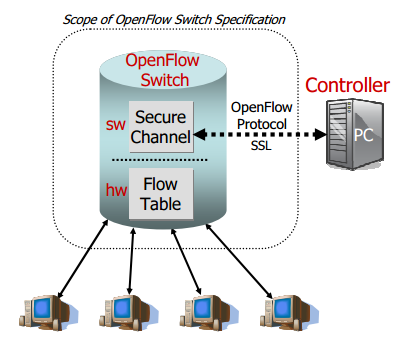
OpenFlow(OF) is meant to be a means of testing new routing or forwarding methods to build these flow tables. It is designed to allow for layer 3 or layer 2 forwarding based on: port, MAC, VLAN, TCP header, or IP header.
The way it accomplishes this is to establish a secure SSH tunnel between the OF switch and the controller. The controller will run whatever this new routeing process is. When a new flow starts, it sends the first packets to the controller. The controller then builds an entry into the flow table to handle the remainder of this connection. This is very reminiscent of Cisco’s original Netflow. Netflow was often referred to as “route once, switch many.” You are probably thinking, “how many connections can this controller sustain?” Their documentation says that a standard PC running controller software should be able to support 10,000 new flows per second. This would be “enough for a large campus network.” This is definitely some heavy lifting.
They also have the ability to segregate the OF flow table from that of the standard switch. The idea is you can choose a handful of ports on a device and have them participate in the OF test. Your controller will then update all of the OF switches in the chain with the new flow information. Since this is a separate flow table the device will continue to process all other traffic based on the standard flow table.
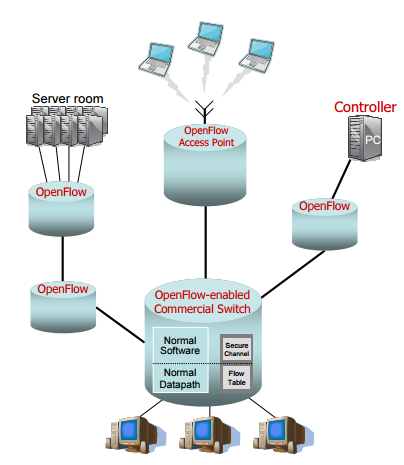
I’ve read that in addition to this you can also have all traffic meeting given criteria to flow to the controller; this would be good for captures. You could also in theory use this to move all traffic sourced from certain ports to flow through an IPS or transparent proxy.
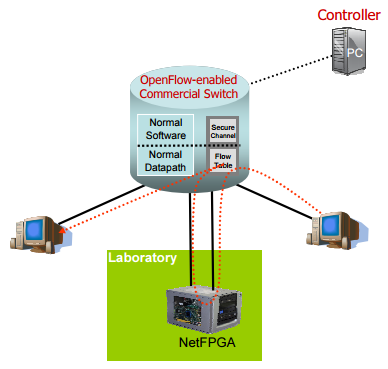
One of the examples I read is if you come up with your own super cool version of OSPF, then you can test it on live traffic without affecting the bulk of your users. I really like the idea of being able to write complex algorithms on my own…:) I can then have that push through the entirety of my Mikrotik domain.
So long as you can maintain the SSH connectivity to the controller you can write your own proprietary mesh algorithm and have the MTKs use it. You could write your own algorithm that monitors all of your ISP interfaces via SNMP and adjust routing on the fly according to congestion…really the sky is the limit at this point.
Right now there are really only two commands in the Mikrotik:
1 2 3 4 5 | #Specify the OF switch and controller address /openflow add name=ofswitch1 controllers=1.1.1.1 #Add ports to the OF switch /openflow port add switch=ofswitch1 interface=ether2 |
BTW, MTK says that since it is so early in the dev state that it is NOT ready for production 😉
There is a list of OF controllers here. There is also a slicer there…more or less a load balancer for the controllers.
Anyone interested in running my proprietary protocol?
I have an old Cisco device that has one port for an octal-cable. This gives you 8 console ports to other routers.

Octal-cable…chicka chicka oooold school
Since I’ve been revamping my lab (AKA cleaning all the crap out of my room) I realized that I needed more console ports. I figured I would look on Ebay to see what I could find and low and behold, the ACS48 was a pretty good steal(I got mine for about $60 shipped).
It really looks like a 1U 48 port switch.
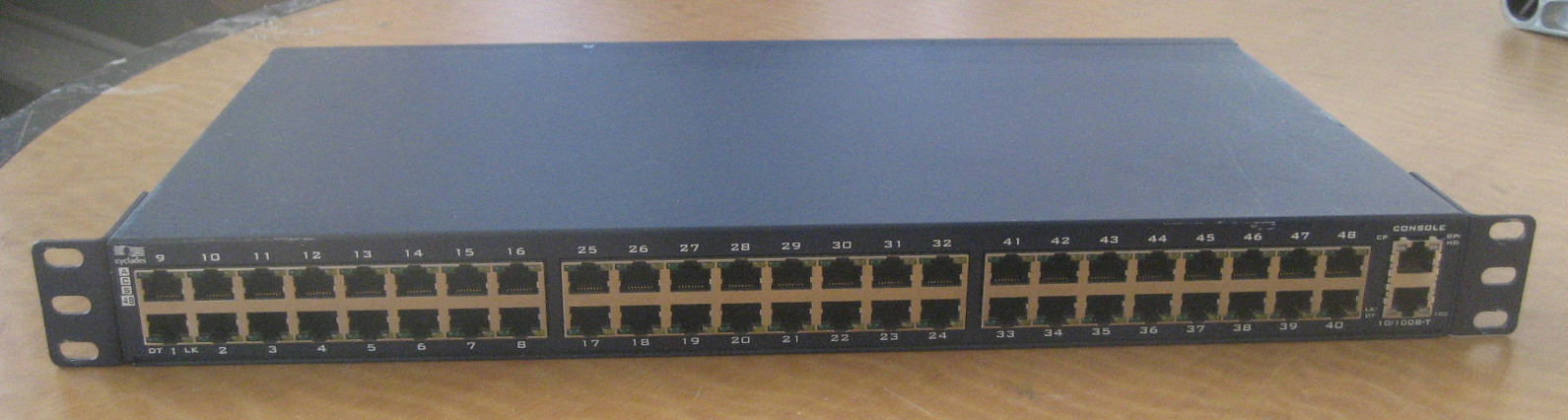
When I got the unit it had a config from the previous owner, so I set about correcting this. It turns out this little guy runs linux. One simply needs to boot the device in single user mode and issue the reset to default command. A fellow in the UK was nice enough to put up a tutorial!
Once that is complete you plug in it’s ethernet port, let it pull a DHCP address, then connect via a browser. You run through a quick setup wizard, then you can connect in earnest.
I chose to basically turn off all security since I’m just using it on my local LAN, but it has HTTP, HTTPS, Telnet, SSH, and direct console.
You can individually configure ports speed and settings, or just apply an across the board setting.
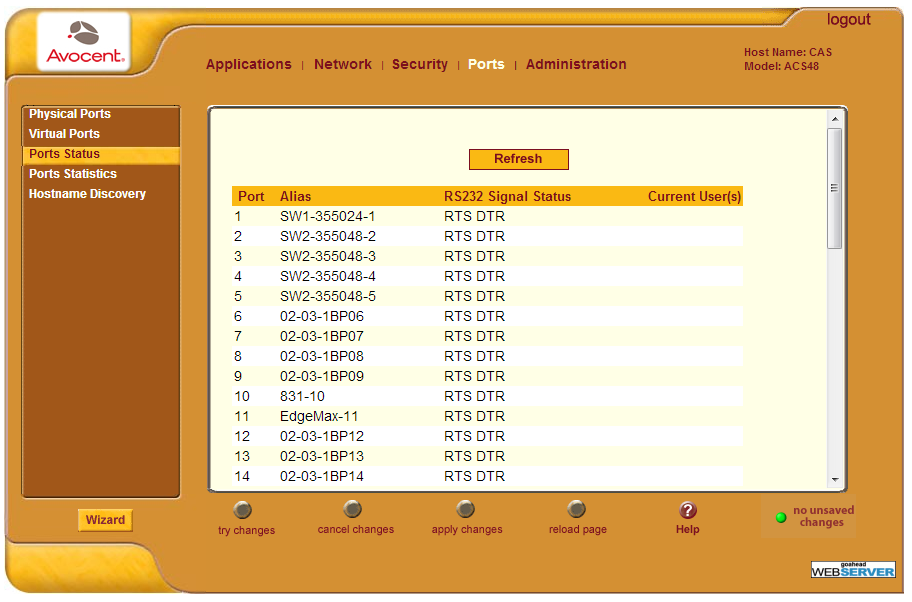
Simple web interface
You also have the ability to select an individual port and connect via a java app to the terminal.

My favorite feature is the ability to telnet/ssh directly to a console port. You connect to the ACS’ IP address via port 7001 for port 1, 7002 for port 2, etc. You can even enable a login system for individual ports or as I did, have it just bridge you straight to the port. As far as security goes you can assign users/groups with varying login permissions per port. You have authentication via local, tacacs, radius, kerberos, ldap…virtually anything.
Ahhh direct telnet access…who needs stinking security credentials!
Cabling is a little odd. Everything I could find on the web said to just use a straight through cable when connecting to Cisco devices. That is exactly what I did…only it didn’t work. No matter what I did it wouldn’t work. I found that you have to swap pins 3 and 6 on one of the connectors. As soon as I changed alllll of the cable ends it worked fine. So if you use type B standard, on one of the connectors swap positions on the greenWhite and green wires. This is lame that you can’t just use regular cables, but it isn’t a deal breaker.
So far I love this device. It boots a little slow, but other than that it works exceedingly well and the price you can get these for is ridiculous.
If you pair this with an RB750 and an alternate internet connection you will have a killer OOB management solution for your network gear.

In this episode we have Myself(Greg Sowell), Justin Wilson, and special guest Tom Smyth.
Tom is a trainer/consultant from Ireland. He is, quite frankly, insane. Inspite of, or more likely because of, his insanity he is also a lot of fun. Even though it was 3AM for him he stuck it out and had a LOT of interesting things to say…it would be impossibly to silence him; and with such a beautiful singing voice, why would you want to? hehehe
Talking about:
Reverse Path Forwarding
Tom’s New Orleans MUM presentation “MTK advanced security”
Tom explains why one would want to separate your sectors.
Of course we had to talk about the CCR(Cloud Core Router) and yes, Don, we mention you 😉
Will X86 survive and why.
Does the CCR need an app store?
Could we get virtualized appliances (IPS, load balancer)?
Anyone want to pay for our trip to the European MUM?…if so, drop me a comment hehehe.
ARIN fees.
IPV6, why we aren’t pushing for it in the states.
BTW, Tom and all of that crazyness will be in Dallas from February 3rd through the 9th. If you want to grab a pint, look him up 😉